
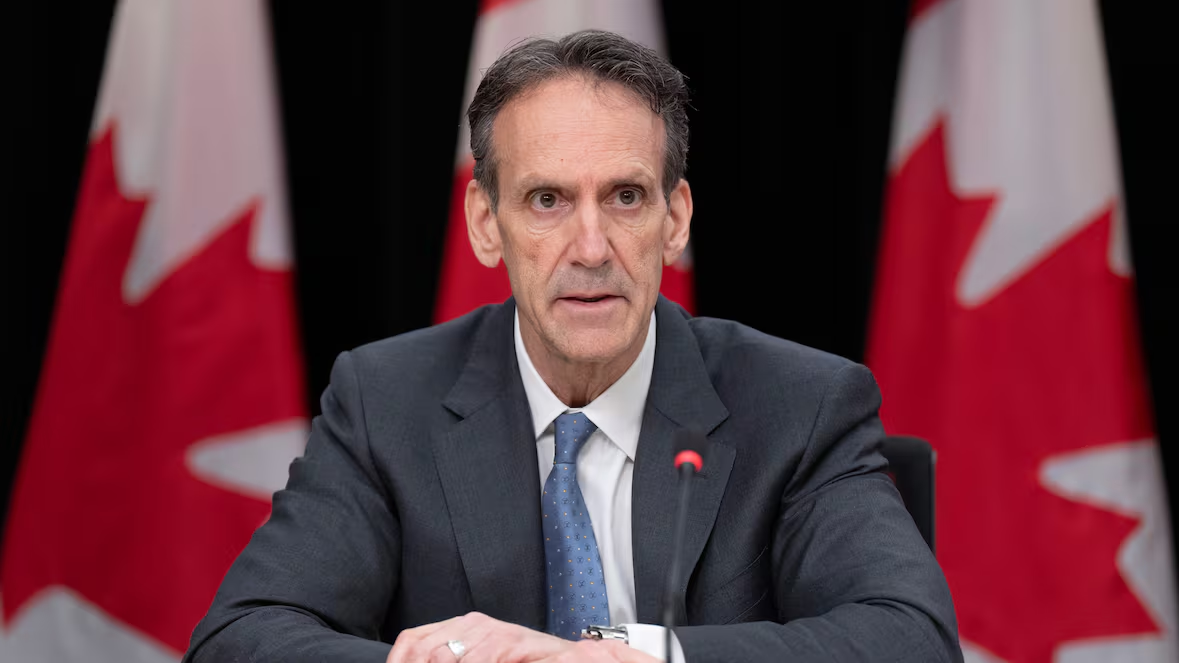
OTTAWA- Canada’s top drug policy official is pushing back heavily against Washington’s assertions that a crackdown at the U.S.-Mexico border is diverting cartel operations and triggering a spike in fentanyl trafficking from Canada. In an interview with CBC’s The House, Canada’s fentanyl czar, Kevin Brosseau, stated that official figures simply do not support American claims of a surging northern pipeline. Pointing to new data from U.S. Customs and Border Protection, Brosseau highlighted that less than half a kilogram of fentanyl was intercepted at the Canada-U.S. border in May, compared to a massive 358 kilograms seized along the southern border with Mexico during the exact same timeframe.
The baseline contrast in border enforcement data is even more staggering when analyzed over the course of the entire year. So far in 2026, U.S. authorities have seized a total of approximately three kilograms of fentanyl at the Canadian border. In stark contrast, seizures at the Mexican border have topped 3,221 kilograms. While Brosseau acknowledged that organized crime syndicates are highly adaptive at altering their smuggling routes, he maintained that the current threat matrix does not match the public rhetoric coming from the United States. He emphasized, however, that Canada cannot afford to let its guard down and must continue to vigilantly monitor local ports and border checkpoints to ensure Mexican cartels do not establish a foothold.
Despite the lopsided data, American officials are refusing to soften their public stance, presenting border security as a mounting friction point with Ottawa. Earlier this week in Washington, U.S. Homeland Security Secretary Markwayne Mullin insisted that law enforcement is observing a noticeable uptick in fentanyl arriving from Canada, blaming the shift on the displacement of Mexican cartels. Mullin argued that the cartels’ demand and business models remain intact, forcing them to seek out alternate vulnerabilities along the northern perimeter. Additionally, Mullin added pressure to the diplomatic back-and-forth by claiming that individuals on the U.S. terrorist watchlist are being apprehended at the Canadian border “almost weekly.”
Amid these cross-border tensions, Canadian health officials have reported a glimmer of hope on the domestic front, expressing cautious optimism over a 23 per cent drop in opioid overdose deaths compared to 2024. Authorities credit the decline—which saw national fatalities drop to 5,630 last year—to shifts in the illicit drug supply chain and much wider community access to the overdose-reversal medication naloxone. Concurrently, data from the Canada Border Services Agency revealed that domestic fentanyl seizures dropped by 43 per cent, falling from 4.9 kilograms in 2024 to 2.8 kilograms in 2025. While Brosseau notes that isolating exact causal links within the drug trade ecosystem is difficult, he remains focused on a zero-tolerance baseline, stating that no amount of fentanyl should be crossing the border into either country.