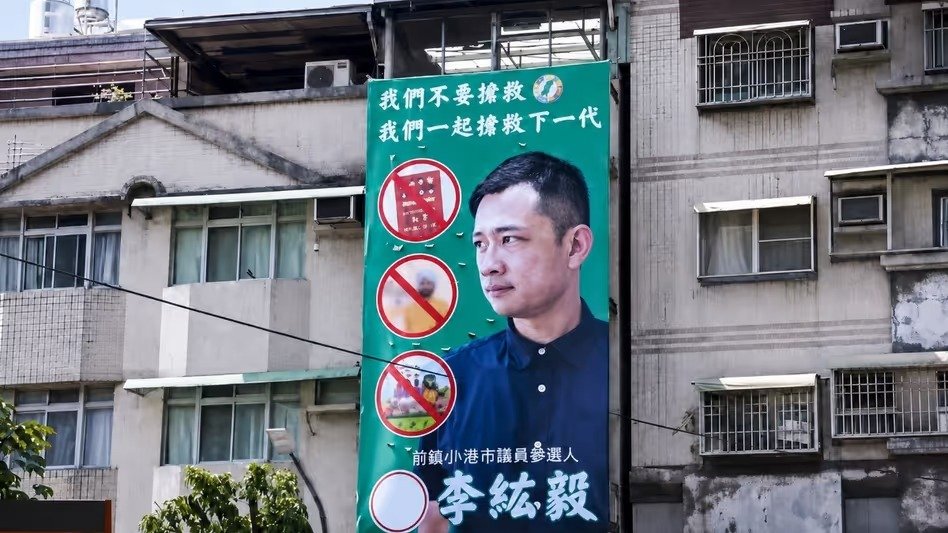
TAIPEI: A political campaign billboard erected ahead of the upcoming local elections in Taiwan has ignited fierce controversy and nationwide debates over racial discrimination. The controversial billboard was put up on Shanming Road in Kaohsiung’s Siaogang District by Lee Hung-yi, an independent candidate contesting the Kaohsiung City Council elections.
The advertisement displays a prominent “prohibition sign” (a red circle with a diagonal slash) superimposed directly over the Indian national flag and an image of a turbaned man. While the candidate claims the display represents his political stance against admitting Indian migrant workers into Taiwan, local political leaders and the expatriate Indian community have vehemently condemned it as a direct and hostile racial slur.
“Blatant Discrimination”: Diaspora and Political Leaders React
The Indian diaspora in Taiwan reacted with intense distress, with members terming the campaign “blatant and direct racial discrimination.” Prominent voices in the community noted that using physical traits, religious attire, and cultural symbols to stir up public resentment crosses the line from legitimate policy debate into hate speech. They also pointed out the sheer ignorance of the advertisement, given that a turban is a sacred symbol of faith and dignity primarily associated with Sikhism, rather than a universal representation of all Indians.
The local political community quickly distanced itself from the campaign. Wang Yi-heng, head of the New Power Party’s Kaohsiung chapter, heavily criticized the independent candidate’s actions, calling the billboard “utterly ignorant” for insulting a foreign country’s flag and disrespecting deeply held cultural and religious traditions.
The backlash comes at a time when over 5,000 highly skilled Indian professionals are already actively contributing to Taiwan’s growth, employed in world-class tech giants like Taiwan Semiconductor Manufacturing Company (TSMC) and Foxconn.
Political Subtext: The Migrant Worker Mobility Debate
The racist campaign leans heavily on anxieties surrounding a Memorandum of Understanding (MoU) signed between India and Taiwan in 2024 to address Taiwan’s severe labor shortages. Under this agreement, the Ministry of Labor is finalizing a cautious pilot program to bring in an initial batch of approximately 1,000 Indian workers to support the manufacturing, construction, agriculture, and caregiving sectors.
However, the main opposition party—the Chinese Nationalist Party (KMT)—has repeatedly stoked fears in parliament regarding the influx. Citing selective criminal statistics from India, KMT politicians have argued that “runaway” migrant workers could pose a threat to women’s safety.
While the Taiwanese government and major industrial sectors firmly reiterate that Indian labor is absolutely essential to offset an aging population and a crashing birth rate, local election dynamics have successfully weaponized the immigration debate, turning it into a toxic row over race and identity.