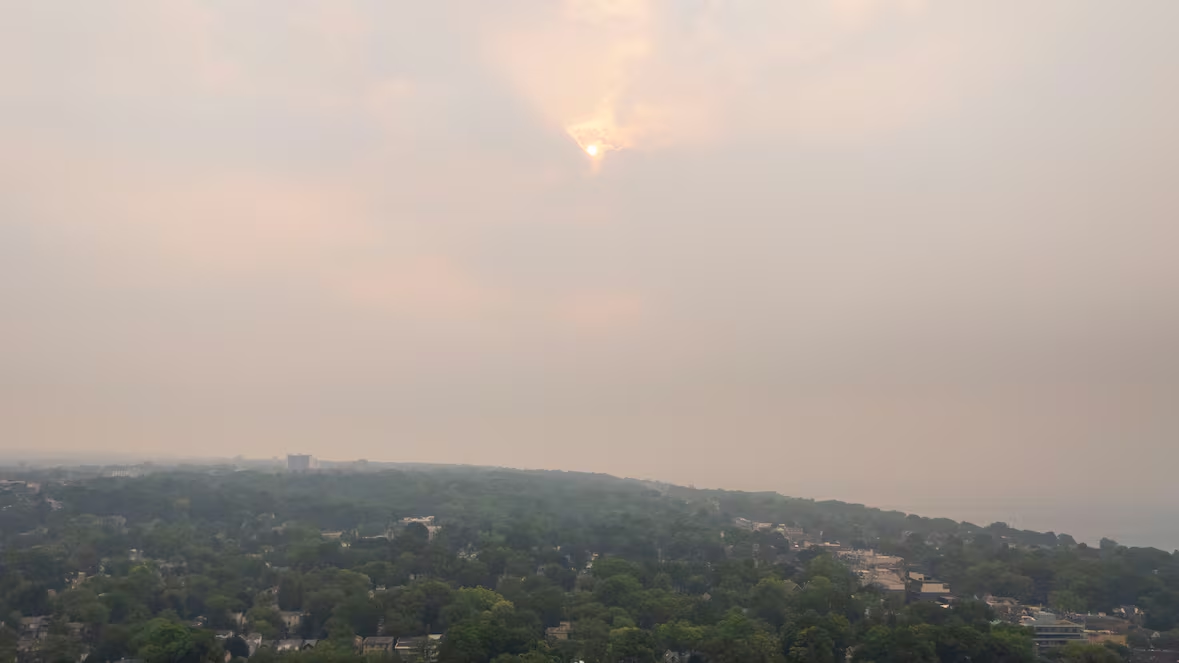
TORONTO- Environment Canada has officially upgraded its air quality warning for Toronto to an orange alert. This escalation comes as heavy smoke from massive, out-of-control wildfires in northwestern Ontario drifts southward, severely impacting visibility and atmospheric safety across much of southern Ontario. The poor air quality, which initially settled into the region on Tuesday night, is forecasted to persist continuously through to Friday morning. Compounding the crisis, the city also remains trapped under a multi-day yellow heat warning.
The sudden influx of fine particulate matter pushed Toronto to the absolute top of the global live index for major polluted cities on Wednesday morning. According to rankings tracked by the Swiss air quality technology company IQAir, Toronto’s air quality temporarily surpassed other traditionally high-pollution zones like Kinshasa and Delhi, registering an “unhealthy” index classification. Environment Canada meteorologist Brian Owsiak detailed that the pollution values spiked rapidly because of the heavy volume of particulate matter carried by the wildfire smoke. Experts indicate a definitive reprieve will only materialize late in the week or over the weekend when shifting wind patterns are expected to flush the heavy plume out of the Greater Toronto Area.
Public health officials and weather authorities are strongly urging the public to take severe precautions. The federal weather agency advised residents to limit time outdoors and proactively reschedule or cancel non-essential sports, events, and outdoor activities. Underscoring the severity of the alert, the University of Toronto cancelled a scheduled FIFA World Cup watch party for the highly anticipated Argentina-England semi-final match. Wildfire management expert Eric Kennedy from York University stressed that under heavy smoke conditions, even brief exposure poses health concerns, recommending that individuals who must travel outside wear well-fitted respirator-type masks like N95s to mitigate particle inhalation.
The dangerous combination of heat and airborne soot presents a wide range of medical risks. While regular exposure typically prompts immediate eye, nose, and throat irritation, headaches, and mild coughing, denser smoke can trigger far more serious conditions like wheezing, prolonged chest pains, and severe coughing fits. Those at the highest risk include individuals over the age of 65, pregnant women, infants, young children, people with chronic respiratory or cardiac illnesses, and outdoor labourers. Despite a minor temperature dip on Wednesday from Tuesday’s blistering high of 36.2°C, actual temperatures still climbed to 33°C, creating a sweltering humidex feeling closer to 36°C.
In response to the extreme environmental convergence, municipal leadership has activated comprehensive relief services. Mayor Olivia Chow announced that the city and Toronto Public Health have opened six dedicated “cleaner air spaces,” including centralized locations at City Hall and Metro Hall, to give residents sanctuary from the toxic air. Furthermore, over 500 cooling spaces have been set up—including a 24-hour location at 136 Spadina Road—while operating hours at eight major public pools have been extended until late in the evening. Mayor Chow expressed deep solidarity with those displaced by the fires, noting that Toronto Public Health remains on standby to aid evacuees arriving from the north.
Despite these city-led adjustments, the double emergency has added immense strain to the city’s vulnerable populations. Street outreach workers point out that finding comprehensive, long-term shelter remains incredibly difficult for the unhoused community during a prolonged crisis. Many individuals are forced to seek out shaded parks or air-conditioned commercial spaces, which feature highly restrictive hours of access. The emergency highlights a worsening environmental trend; the city has already clocked 13 days exceeding 30°C this year, nearly doubling the historical average of seven days usually recorded by mid-July. Medical officers warn that heat stroke can set in rapidly under these conditions, advising anyone experiencing dizziness, confusion, or nausea to immediately contact 911.