
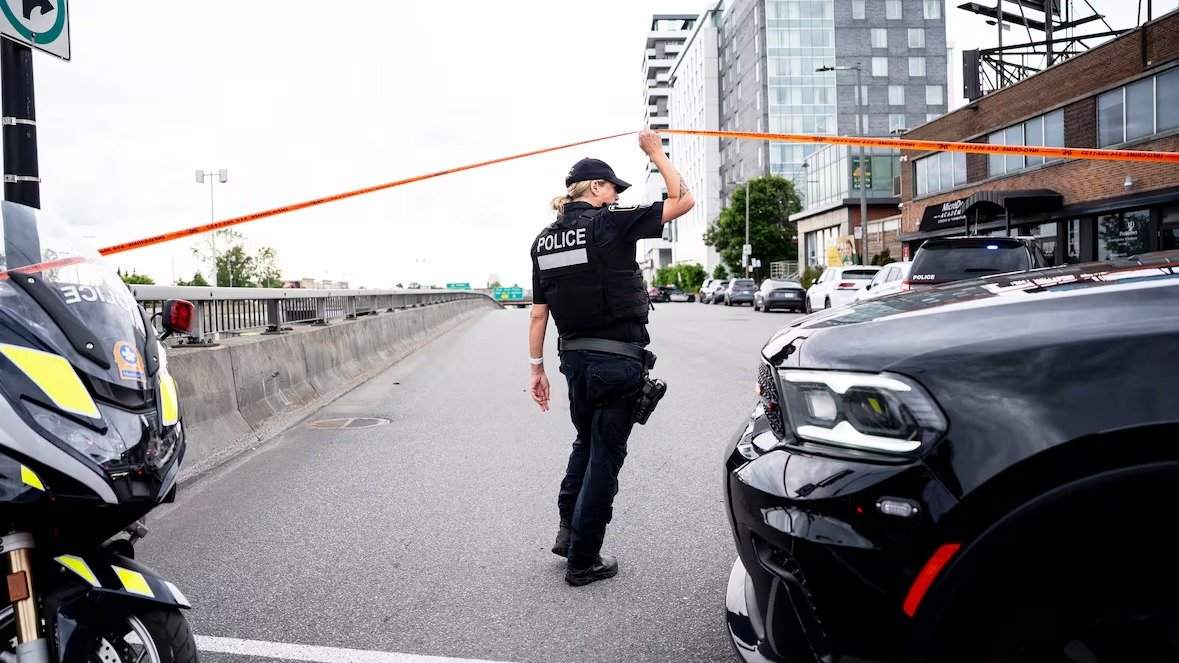
MONTREAL: A series of recent on-duty deaths among Canadian law enforcement officers has sparked widespread national concern. The latest incident occurred last Monday during an armed standoff at a hotel in the Côte-des-Neiges neighbourhood of Montreal, leaving a police officer and a suspect dead, while another officer and a bystander sustained injuries. Marking the third officer fatality in Canada in less than two weeks, the tragedy has raised urgent questions about whether targeted violence against the police is on the rise.
The Montreal shooting came just one day after two RCMP officers were shot and injured while responding to a call for assistance in Melville, Saskatchewan. Despite the alarming frequency of these back-to-back incidents, criminologists and researchers who track law enforcement fatalities urge caution, noting that the overall numbers for the year remain well within historical ranges. Justin Piché, a criminology professor at the University of Ottawa who has compiled data on intentional harms against police dating back to the 1960s, emphasized that a sudden cluster of deaths does not automatically signal a new trend or a rising wave of violence. He pointed out that officers are statistically less likely to die from intentional harm now than in previous decades.
So far in 2026, four Canadian police officers have died in the line of duty, three of whom were victims of intentional attacks. Interestingly, the years 2024 and 2025 recorded zero on-duty police fatalities across Canada—an unprecedented anomaly in 64 years of data. In contrast, eight officers died on duty in 2023, with six of those deaths resulting from intentional violence. Looking at the broader timeline from 1962 to 2026, Canada has seen a total of 415 on-duty police deaths, averaging about 6.5 per year. Commenting on the situation, Quebec’s Minister of Domestic Security, Ian Lafrenière, stated during a press conference that the events in Montreal remain “extremely rare.”
Data shows that traffic accidents remain the leading cause of death among on-duty personnel, closely followed by gunfire. Recent tragedies reflect these occupational hazards. In April, 33-year-old Ontario Provincial Police (OPP) Sgt. Brandon Malcolm died in a motorcycle crash outside Toronto. On June 9, OPP Const. Tarun Bali was killed while attempting to stop a vehicle near Hearst, Ontario, leading to dangerous driving charges against an 18-year-old hospital escapee. Just days later, on June 11, Toronto Police Const. Marc Pinizzotto, 43, was fatally shot during an apartment search. Other violent encounters include a June 14 incident where a 12-year-old boy was charged with attempted murder after striking a Toronto officer with a stolen car, and a separate shooting in Mississauga where a 24-year-old man was arrested for firing at an officer.
Addressing the cultural factors behind these confrontations, Greg Brown, an adjunct professor at Carleton University and a former Ottawa police officer, noted a distinct societal shift in public trust towards law enforcement over the last two decades. This eroding confidence has not only created a challenging environment on the streets but has also severely hampered police recruitment. Brown also highlighted the proliferation of illegal firearms—such as high-capacity magazines and assault-style weapons—alongside the glorification of gang culture as key drivers behind recent shootings. While experts note that many of these incidents involve young men, they conclude that it is still too early to draw definitive conclusions about the root causes of this recent cluster of violence.