
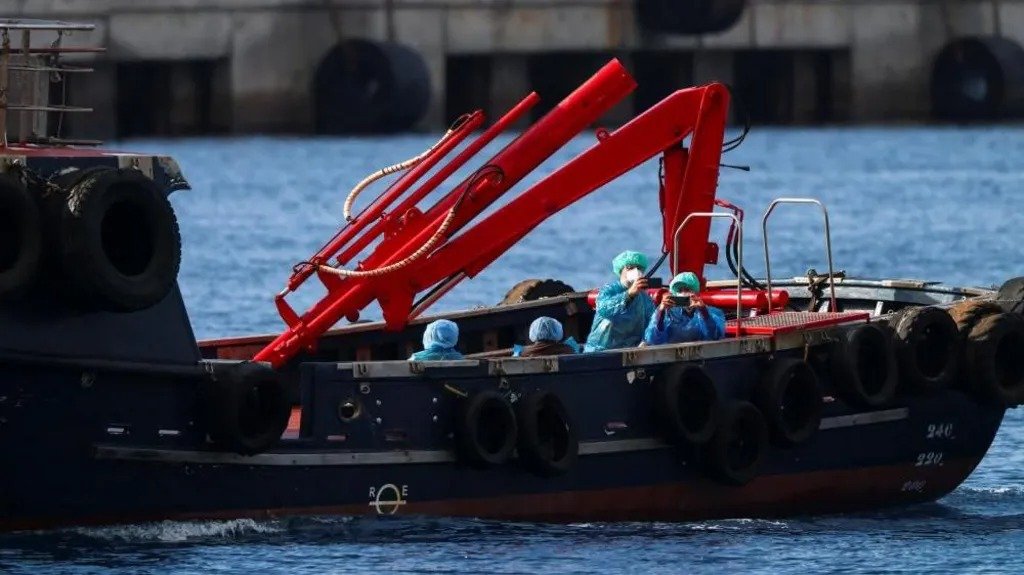
TENERIFE (Spain) – The Spanish government has initiated an emergency evacuation of passengers from the cruise ship ‘MS Hondius’ after the vessel spent weeks in legal and medical limbo at sea. The crisis began following an outbreak of the deadly Hantavirus, which reportedly originated during a stop in Argentina. The ship anchored off the coast of Tenerife early Sunday morning under a heavy security presence, ending a period of intense uncertainty for those on board. To minimize any risk of local transmission, the Ministry of Health refused to let the vessel dock at the pier, forcing the ship to remain one nautical mile offshore while passengers were ferried to land in small batches via secure shuttle boats.
The evacuation process began with the repatriation of 14 Spanish citizens, who were immediately transported by a specialized military aircraft to a dedicated hospital in Madrid for a mandatory quarantine. Following them, passengers from the Netherlands, Greece, and Germany were processed and prepared for transit. Authorities have confirmed that chartered flights are being organized for British and American travelers, while Australian nationals are expected to depart by Monday. Despite the departure of the passengers, approximately 30 crew members will remain on the MS Hondius to navigate the vessel back to its home port in the Netherlands.
On the shore, the scene was one of clinical precision, with medical teams and security officials dressed in full Personal Protective Equipment (PPE) to receive the travelers. The Spanish Ministry of Health has placed the Candelaria Hospital in Tenerife on high alert, equipping isolation wards with specialized ventilators to handle any sudden medical emergencies. Health experts believe the virus was contracted at a landfill site in Argentina where it is typically spread by rodents. While human-to-human transmission of Hantavirus is generally rare, the deaths of three passengers during the voyage have sparked significant international concern and prompted a highly cautious response from European officials.
Addressing the public’s anxiety, World Health Organization (WHO) Director-General Tedros Adhanom Ghebreyesus arrived in Tenerife to personally monitor the situation. He urged the local population to remain calm, stating that the risk of a wider outbreak is extremely low. His visit followed local protests and concerns voiced by Canary Islands President Fernando Clavijo, who feared that rodents from the ship could potentially carry the virus to the islands. However, health officials have dismissed these fears, emphasizing the strict distance maintained between the ship and the shore. Because the virus has a lengthy incubation period of up to nine weeks, all evacuated passengers will be subject to rigorous medical monitoring and isolation in the coming months.