
OTTAWA — The Royal Canadian Air Force (RCAF) will not receive its first newly built air-to-air refueling tanker until late 2027, posing ongoing challenges for long-range Arctic air defense and fighter jet operations.
Canada is acquiring nine Airbus A330 aircraft—designated as the CC-330 Husky—under a C$3.6 billion Strategic Tanker Transport Capability program to replace its aging fleet of CC-150 Polaris aircraft (modified Airbus A310s). The multi-role fleet will handle troop transport, aeromedical evacuations, strategic transport for top government officials (including the Prime Minister), and aerial refueling for fighter jets over vast distances.
Fleet Status and Staggered Delivery
The C$3.6 billion procurement includes five commercial used aircraft and four newly manufactured models:
- Used Aircraft: Three have already arrived in Canada and are primarily used for passenger and cargo transport. A fourth is in Switzerland undergoing cabin and self-protection upgrades. The fifth used jet is currently at Airbus facilities in Getafe, Spain, undergoing military conversion into a Multi-Role Tanker Transport (MRTT).
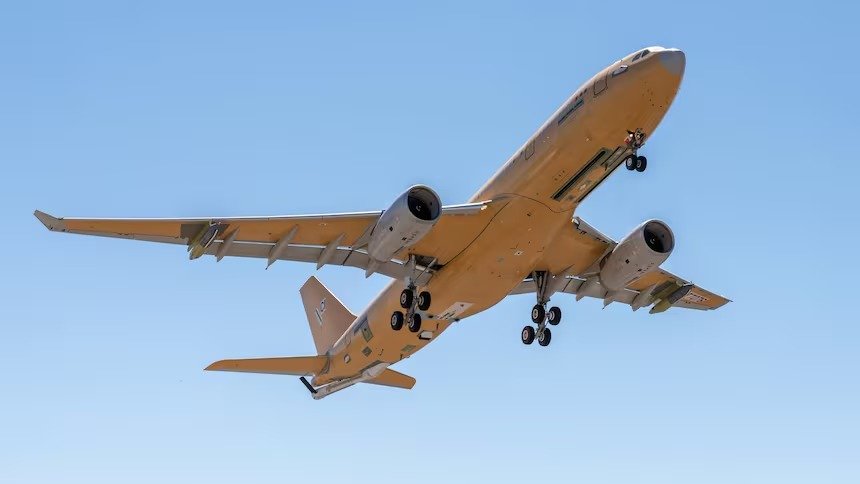
- New Aircraft: The first newly built A330 completed its maiden test flight in Spain, with three others under construction in Toulouse, France. Full delivery of the first MRTT-configured tanker is set for late 2027.
Critical Impact on Arctic Defense
Aerial refuelers are vital for extending the range and loiter time of Canada’s existing CF-18 Hornet fighters and incoming F-35 stealth fighters while patrolling the vast Canadian Arctic.
The legacy CC-150 Polaris fleet lacks the flying boom system required to refuel aircraft like the F-35A. The CC-330 Husky will feature both NATO-standard flying boom and hose-and-drogue systems, enabling it to refuel Canadian, U.S., and NATO allied aircraft seamlessly.
The RCAF expects the Husky fleet to reach Initial Operational Capability (IOC) between 2028 and 2029, with Final Operational Capability (FOC) targeted for 2032–2033.
Enhanced Security for V-VIP Transport & Legacy Fleet Bridge
The dedicated government transport variant (V-VIP aircraft) undergoing upgrades in Switzerland will feature advanced self-protection countermeasure suites—including missile defense systems such as directional infrared lasers and flares—to ensure secure transport for high-ranking government officials.
Until the CC-330 Husky fleet achieves full operational capability, Canada will continue relying on three remaining CC-150 Polaris aircraft, which entered service in the late 1980s. Following an accident in Guam in 2023 that wrote off one Polaris aircraft, the remaining three are scheduled to stay operational until 2030.