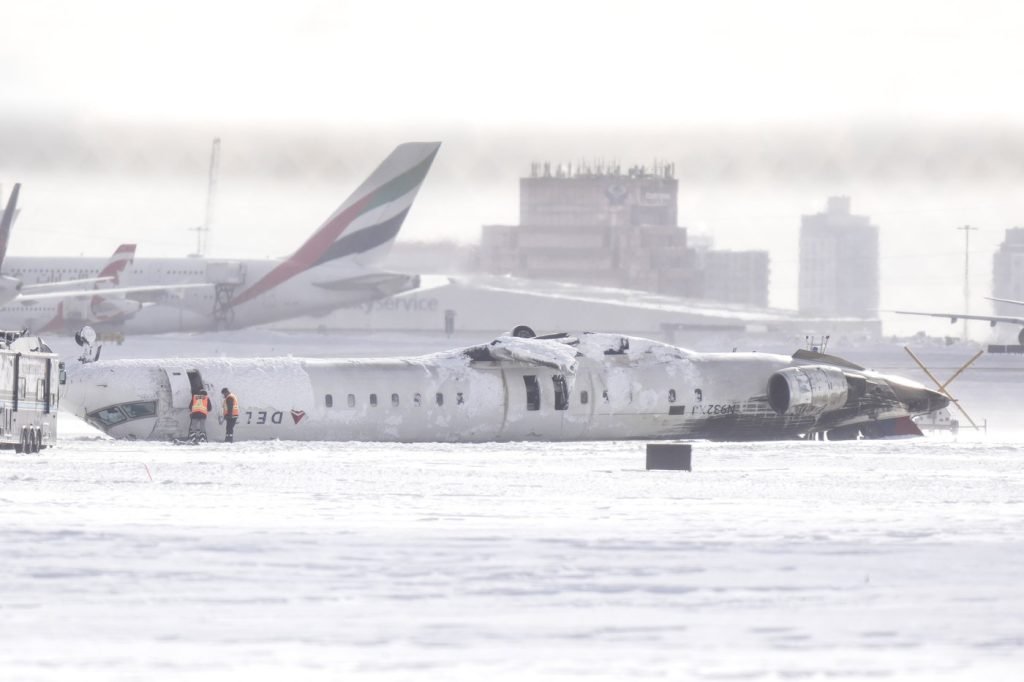
TORONTO – Today marks the first anniversary of the terrifying crash of Delta Air Lines Flight 4819 at Toronto Pearson International Airport, an event that remains a vivid and painful memory for those on board. On February 17, 2025, the flight from Minneapolis, operated by Endeavor Air, attempted to land during a period of heavy snow and high winds. The aircraft struck the runway with such force that its landing gear collapsed and a wing detached, causing the plane to flip upside down and burst into flames. While all 76 passengers and 4 crew members miraculously escaped the burning wreckage, the physical and emotional toll continues to haunt them one year later.
Survivors recount a harrowing scene of being suspended upside down by their seatbelts in a cabin filled with the smell of jet fuel and smoke. For many, like Minnesota resident John Nelson, the trauma has been life-altering. Nelson, a former Ironman triathlete, suffered a torn retina and serious spinal injuries that ended his athletic career and left him battling chronic pain and deep depression. Similarly, passenger Nate Richie continues to struggle with a traumatic brain injury and persistent back pain. The psychological impact has been so severe that Richie now avoids flying entirely, recently opting for a 14-hour drive to visit family rather than boarding a plane.
The legal battle for accountability is intensifying as survivors seek more than the initial compensation offered. While Delta Air Lines offered a “no strings attached” payment of $30,000 per passenger shortly after the crash, many survivors have rejected this as insufficient for their lifelong injuries and mental anguish. Attorneys for the passengers argue that the accident was entirely preventable, alleging that the pilots were landing at an “abnormally high speed” and failed to adhere to safety protocols during the storm. A master complaint has been filed in U.S. court seeking full damages for the “reckless” operation of the flight.
Meanwhile, the Transportation Safety Board of Canada (TSB) is still in the “examination and analysis” phase of its investigation. Preliminary data suggested the aircraft was descending at roughly 1,100 feet per minute—significantly higher than a normal approach—and may have been pushed by a sudden wind gust. Investigators have conducted simulator exercises and metallurgical tests on the landing gear to determine the exact sequence of the mechanical failure. As the community reflects on the anniversary, survivors are calling for more than just a final report; they are demanding stricter safety standards and a formal apology for a tragedy they believe should never have happened.