ST. JOHN’S — Newfoundland and Labrador’s Indigenous Relations and Reconciliation Minister, Lela Evans, has stated the provincial government remains firmly dedicated to “true reconciliation” with the Innu people. However, she stopped short of officially endorsing historical evidence that places the Innu presence in the region beyond 300 years.
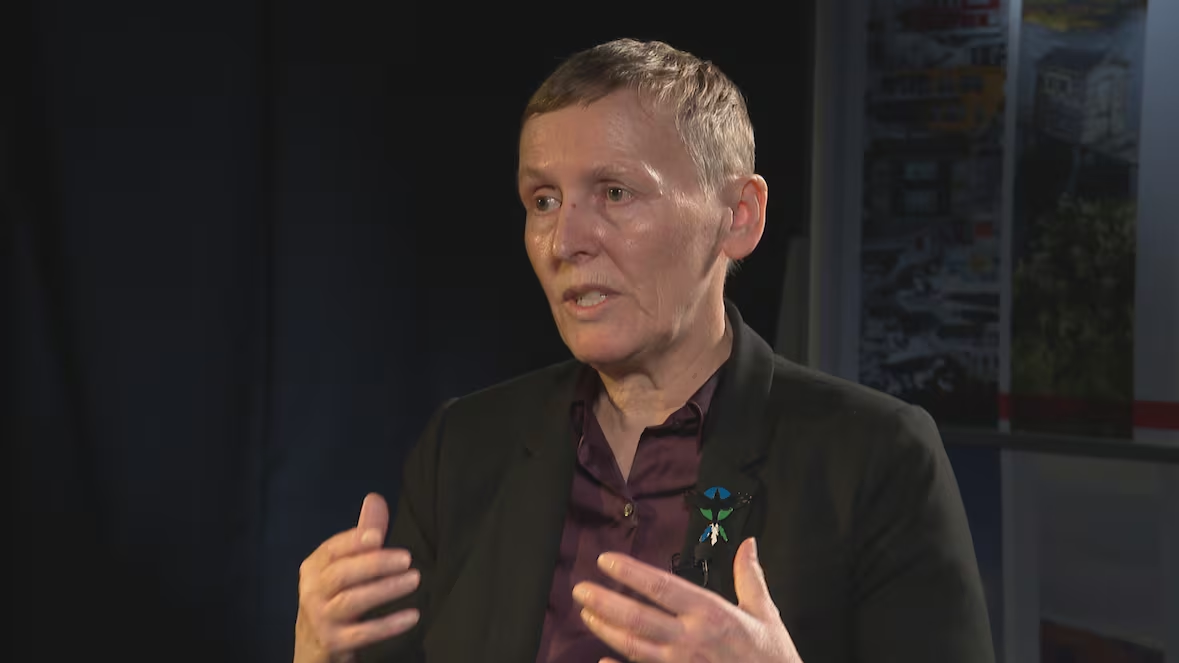
In a one-on-one interview with CBC, Evans addressed the controversy for the first time following the Innu Nation’s decision to cancel a planned Innu-led cultural exhibit at the Labrador Interpretation Centre in North West River.
The exhibit was cancelled after Innu cultural guardian Jodie Ashini accused The Rooms—the provincial Crown corporation that operates the centre—and the Provincial Archaeology Office of attempting to place a historical “cap” of 300 years on Innu heritage, preventing the community from presenting its history unfettered.
Minister Pledges Investigation into Timeline Dispute
While Evans acknowledged that Indigenous peoples have inhabited Labrador for much longer than three centuries, she refrained from explicitly confirming that the Innu specifically have been there longer, despite repeated questioning.
“I know the Inuit have been here for much longer than 300 years,” Evans said. “And so I’d like to be able to go back now and say, ‘OK, what needs to be done to show, to document the Innu’s presence?'”
Evans, who is Indigenous herself, promised to do everything in her power to protect Innu rights and “get to the bottom of this 300 years.” She noted that if independent experts are challenging the province’s stance, a formal review is necessary. A group of eight prominent anthropologists and archaeologists recently authored a joint letter supporting the Innu Nation’s historical timeline and criticizing the provincial agencies’ rigid approach.
“If people are countering what The Rooms and the provincial archaeologists are saying, well then to be transparent we have to make sure we review that,” Evans stated, adding that the government would not shy away from controversial topics.
Innu Leadership Rejects Minister’s Stance
The minister’s comments were met with sharp criticism from Innu cultural guardian Jodie Ashini, who expressed deep frustration over having to defend her people’s ancient lineage.
“It’s mind-boggling that we’re even in this position right now, to have to try and fight to say we were here longer than Europeans. It’s very, very disappointing,” Ashini said.
Ashini also strongly rejected Evans’ assertion that the historical dispute has no bearing on ongoing Innu land claim negotiations. According to Ashini, a specific “heritage chapter” remains one of the primary obstacles delaying the final settlement of their land claim agreement.
Furthermore, Ashini cautioned the minister against relying solely on internal government bodies like the Provincial Archaeology Office for answers, urging her to consult with “a non-biased archaeologist” to establish the facts independently.
The Rooms has continually refused to comment on the matter, referring all media inquiries back to the provincial government. Andrea Barbour, the minister responsible for the Crown corporation, was out of the country on official business during the dispute.